
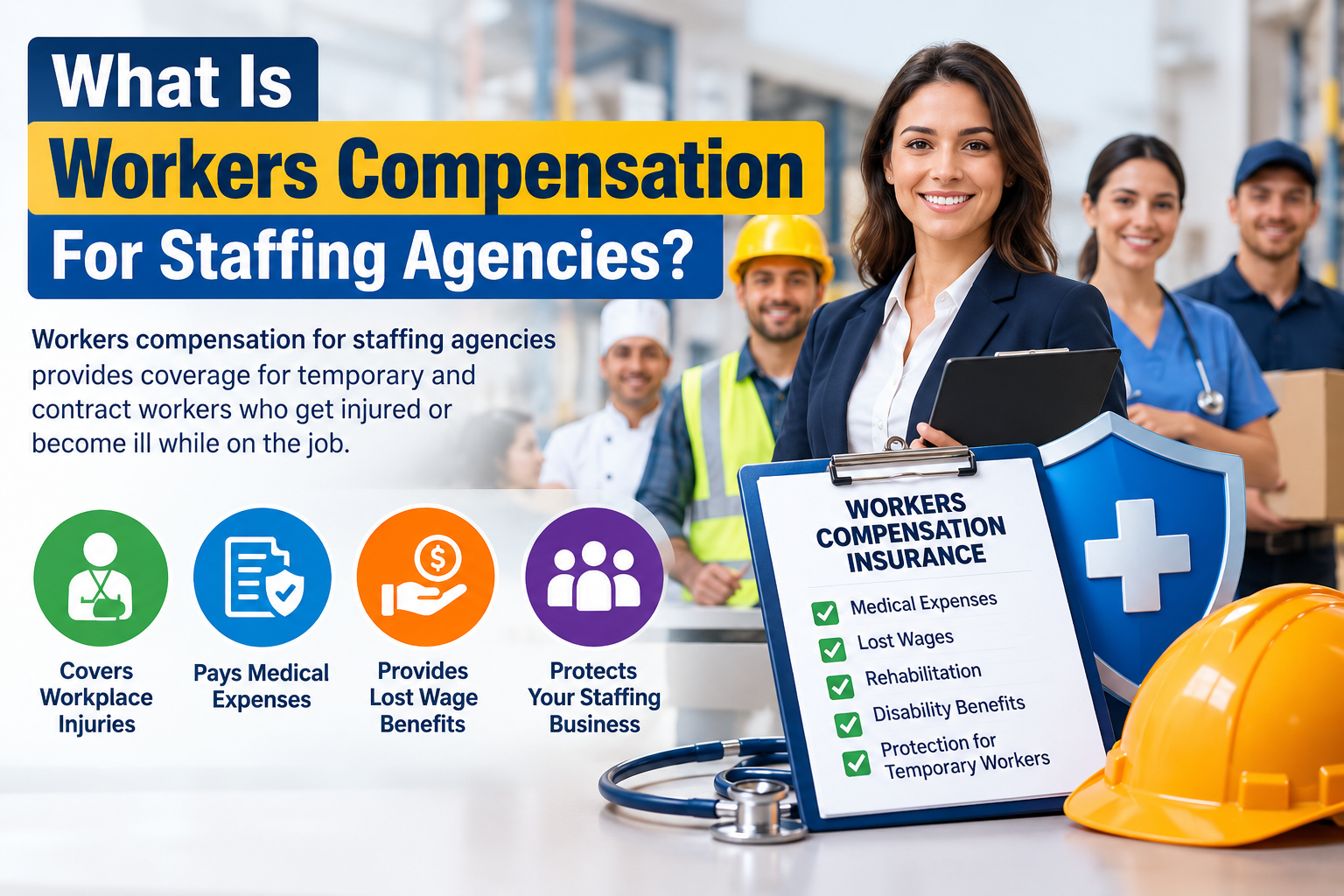
What Is Workers Compensation For Staffing Agencies?
Workers compensation for staffing agencies is insurance coverage that protects employees who suffer a work-related injury or illness and helps the staffing business meet its workers compensation responsibilities. This is especially important when an agency hires employees and assigns them to work at different client businesses. Redvo Insurance Solutions has 15+ years of experience in insurance, and staffing agencies can contact the team at 1800-411-0733 to discuss their workers compensation requirements and available coverage options. Understanding how coverage works, who is responsible after an injury, and what information an insurer needs can help a staffing agency manage its workforce more effectively.
Workers compensation is a system that provides benefits to employees who suffer qualifying work-related injuries or illnesses. Depending on the circumstances, benefits can include medical care, temporary disability benefits, permanent disability benefits, supplemental job displacement benefits, return-to-work benefits and death benefits.
- For a staffing agency, workers compensation can be more complicated than it may appear because employees often perform their assigned work at a client’s workplace.
- The staffing agency may handle hiring, payroll and other employment responsibilities, while the client controls the employee’s day-to-day work environment. California recognizes these staffing arrangements as employment relationships that can involve a staffing agency and the business where the employee performs work.
- That makes it important to clearly understand the responsibilities of the staffing agency, the client and the workers compensation insurer.
Why Do Staffing Agencies Need Workers Compensation Insurance?
Staffing agencies need appropriate workers compensation coverage because their employees can experience workplace injuries or illnesses just like employees in other businesses.
In California, employers generally must provide workers compensation benefits to employees, including businesses with one or more employees. California’s Department of Industrial Relations states that employers must have workers compensation insurance unless they qualify for an applicable self-insurance arrangement.
For staffing agencies, the need for proper coverage is particularly important because employees may be assigned to different clients, workplaces and job duties.
For example, a staffing agency could place one employee in an office and another employee in a warehouse or other physically demanding environment. The nature of the work can affect the agency’s insurance exposure, so the insurer should receive accurate information about the business and the work performed.
How Does Workers Compensation Work For Temporary Staffing Employees?
Temporary staffing arrangements can involve a staffing agency and a client business working together.
California’s Division of Occupational Safety and Health explains that temporary agency employees can have a dual-employer arrangement. The temporary staffing agency that pays the employee can be considered the primary employer, while the business where the employee works can be the secondary or host employer.
This distinction matters when establishing responsibilities for workplace safety, injury reporting and workers compensation.
Before an employee starts an assignment, the staffing agency and client should have a clear understanding of:
Who employs the worker
What work the employee will perform
Where the employee will work
Which workers compensation coverage applies
How workplace injuries must be reported
Who should receive an injury report
What safety information the employee needs
What documentation must be maintained
Clear communication can reduce confusion when an employee is injured.
What Does Workers Compensation Cover?
Workers compensation can provide benefits for qualifying work-related injuries and illnesses. In California, these benefits can include medical treatment, temporary disability, permanent disability, supplemental job displacement benefits and death benefits, depending on the circumstances of the claim.
For staffing agencies, the important issue is making sure the coverage reflects the actual workforce.
The agency should provide accurate information about employee duties, payroll and business operations when obtaining or reviewing coverage. If the agency begins supplying employees for substantially different types of work, its insurance information may need to be reviewed.
Workers compensation should therefore be treated as an ongoing business requirement rather than something that only needs attention when a policy is first purchased.
What Happens If A Staffing Employee Gets Injured?
A staffing agency should have a clear process for handling workplace injuries.
In California, an employer must provide or mail a workers compensation claim form, known as the DWC 1, within one working day after learning about an employee’s work-related injury or illness. The completed claim information must then be processed and forwarded according to the applicable requirements.
For a staffing agency, quick communication is especially useful because the injury may happen at a client location.
A practical injury-reporting process should identify:
Who the employee contacts after an injury.
How the client reports the incident to the staffing agency.
Which claims contact receives the information.
What forms need to be completed.
How the incident is documented.
How communication with the injured employee is maintained.
The agency should also make sure employees and client supervisors understand the reporting process before an accident occurs.
What Should Staffing Agencies Consider When Choosing Coverage?
Price is only one factor when reviewing workers compensation insurance.
A staffing agency should first make sure the insurer understands its actual business operations, workforce and job assignments. California’s DWC advises employers to consider factors including insurer services, access to claims adjusters and medical-provider networks when selecting workers compensation coverage.
Important questions include:
Are employee classifications accurate?
Is the payroll information current?
Are job duties properly described?
Does the coverage reflect the agency’s current operations?
How are claims reported?
What claims support is available?
What insurance documents do clients require?
Does the policy need review when new types of assignments are added?
Staffing agencies should also review insurance requirements included in their client agreements. A client may require specific certificates or coverage terms before allowing employees to begin an assignment.
Common Workers Compensation Mistakes Staffing Agencies Should Avoid
Several problems can make workers compensation more difficult to manage.
- Using inaccurate business information: If payroll, job duties or other underwriting information changes, the agency should review whether its insurance information remains accurate.
- Assuming the client handles everything: A staffing agency should not automatically assume that sending an employee to a client workplace transfers all employment or workers compensation responsibilities.
- Delaying injury reporting: Employees and client supervisors should know who to contact immediately after a workplace injury.
- Ignoring changes in operations: Adding new industries, job types or substantially different assignments can change the agency’s insurance exposure.
- Failing to document responsibilities: Written agreements and clear procedures can help the agency and client understand who handles specific tasks.
How Much Does Workers Compensation Cost For A Staffing Agency?
There is no single workers compensation price for every staffing agency.
Premiums can be affected by factors such as payroll, employee classifications, types of work performed, claims history and other underwriting considerations. An agency supplying employees for higher-risk work may have different insurance costs from an agency primarily supplying office workers.
That is why a staffing agency should provide current and accurate business information when requesting a quote.
Instead of relying on a general online estimate, an agency can discuss its actual workforce, payroll, job duties and client assignments with an insurance professional to understand the available options.
Workers Compensation Requirements For Staffing Agencies In California
California requires employers to provide workers compensation benefits to their employees, generally beginning with one employee. The state also recognizes staffing and temporary employee arrangements in which employees may work at another business’s location.
This means staffing agencies should pay close attention to both insurance coverage and the structure of their employment relationships.
When an employee is injured, California also has specific requirements concerning the workers compensation claim process. The DWC 1 claim form is an important part of that process, and employers have specific responsibilities after learning about a work-related injury or illness.
Because requirements can depend on the facts of a particular employment arrangement, staffing agencies should verify current requirements and discuss their specific circumstances with an appropriate insurance or legal professional when necessary.
How Redvo Insurance Solutions Can Help Staffing Agencies
Redvo Insurance Solutions has 15+ years of experience in insurance and can help staffing agencies discuss their workers compensation insurance requirements.
Every staffing agency has its own workforce, payroll, job assignments and client arrangements. A useful insurance review should therefore start with the agency’s actual business operations rather than applying the same approach to every staffing company.
If you need help reviewing workers compensation insurance for your staffing agency, you can contact Redvo Insurance Solutions at 1800-411-0733 to discuss your requirements and available coverage options.
Questions Staffing Agencies Should Ask Before Buying Workers Compensation Insurance
Before choosing coverage, a staffing agency can ask:
Does the policy reflect the work our employees actually perform?
Are our employee classifications accurate?
How should we report a workplace injury?
What information does the insurer need for a quote?
How are claims handled?
What happens when we add new types of workers or assignments?
What insurance documents will our clients require?
Are there any coverage limitations or exclusions we should understand?
Getting clear answers before purchasing coverage can make it easier to compare options and identify issues that may otherwise be overlooked.
Conclusion
Workers compensation for staffing agencies is an important part of managing employees who may work across multiple client workplaces. The agency needs to understand its employment relationships, employee duties, payroll, client requirements, insurance coverage and injury-reporting process.
For staffing agencies operating in California, workers compensation requirements apply broadly to employers, while temporary staffing arrangements can involve both the staffing agency and the host business.
The best starting point is accurate information about the agency’s actual workforce and operations. Redvo Insurance Solutions has 15+ years of experience and can be reached at 1800-411-0733 if you want to discuss your staffing agency’s workers compensation insurance needs.