
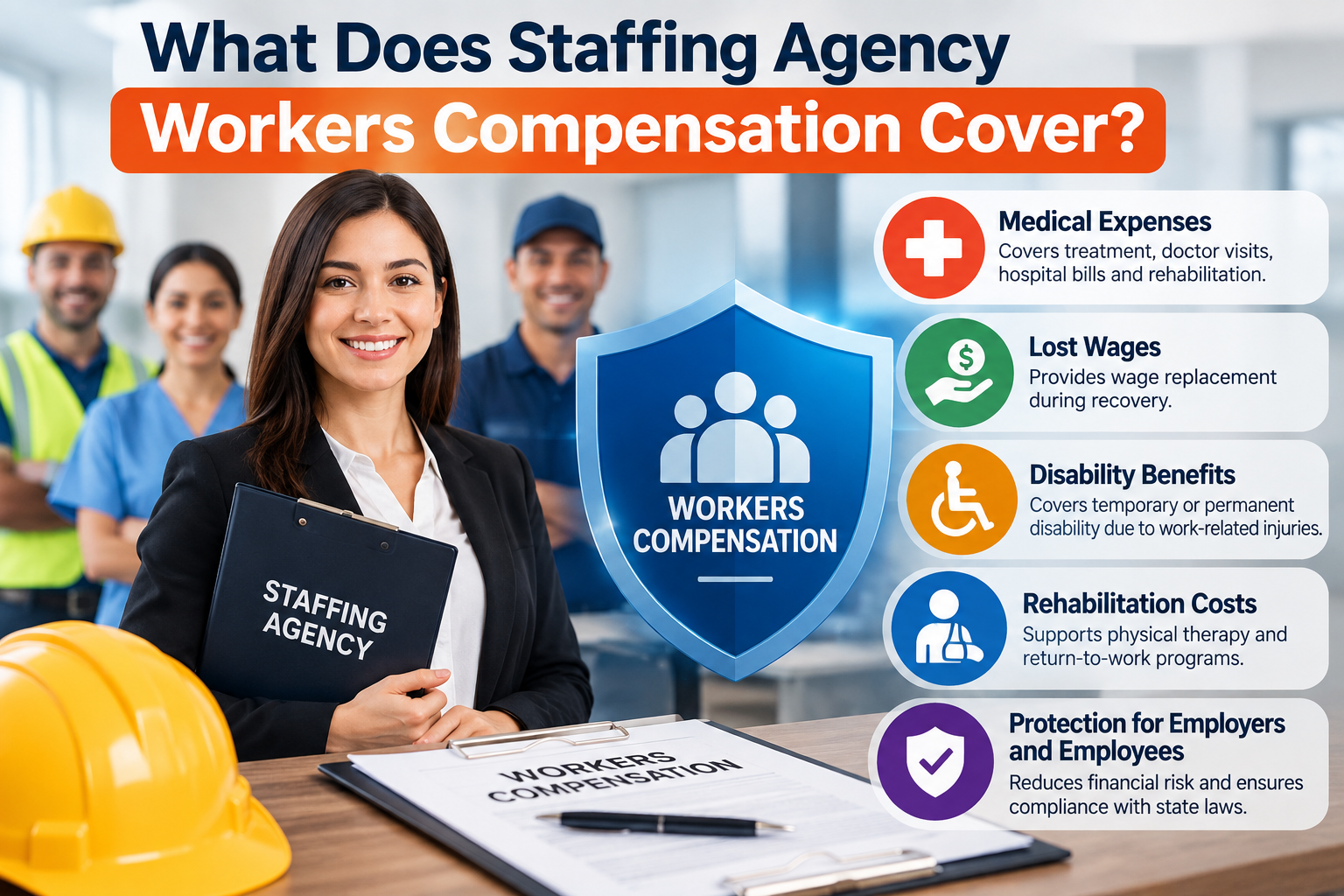
What Does Staffing Agency Workers Compensation Cover?
Staffing agency workers can be placed in many different jobs and work environments. When an employee suffers a work-related injury or illness, workers compensation insurance can help pay for eligible medical care and provide income-related benefits while the employee recovers.
For a staffing agency, workers compensation is more than a policy requirement. It provides financial protection when an employee is injured and gives the agency a structured process for handling workplace injury claims The exact benefits available depend on the injury, the employee’s situation, the insurance policy, and the workers compensation rules that apply. Workers compensation generally covers qualifying injuries and illnesses that are connected to an employee’s work.
For staffing agencies, covered situations can occur while an employee is performing assigned duties for a client business. The employee’s work does not have to be performed inside the staffing agency’s own office for workers compensation issues to arise.
Common areas of coverage can include:
Medical treatment
Temporary disability benefits
Permanent disability benefits
Supplemental job displacement benefits
Death benefits
Other benefits provided under the applicable workers compensation system
Workers compensation is intended to help an injured employee receive necessary care and replace part of lost income when the employee cannot work because of a covered work-related injury or illness.
Does Workers Compensation Cover Medical Treatment?
Yes, medical care is one of the main benefits provided through workers compensation for a covered work-related injury or illness.
Depending on the claim, medical treatment may include care needed to diagnose, treat, and help the employee recover from the workplace injury.
For a staffing agency, this can be particularly important because employees may be working at a client’s workplace when an accident occurs.
The employee should report the injury promptly so the appropriate claim process can begin.
Does It Cover Lost Wages?
Workers compensation can provide temporary disability benefits when a work-related injury prevents an employee from performing their usual job during recovery.
These benefits are designed to partially replace wages lost because of the injury. The amount and duration depend on the applicable rules and the employee’s circumstances.
For staffing agencies, this matters because an injured employee may be unable to continue a temporary assignment even when the assignment was expected to last only a limited period.
What If The Employee Has A Permanent Disability?
Some workplace injuries may result in lasting limitations.
When a covered injury results in permanent disability, an employee may qualify for permanent disability benefits. The amount depends on factors such as the extent of the disability and the applicable workers compensation rules.
A serious injury does not automatically mean an employee will receive permanent disability benefits. The claim must be evaluated based on the medical and legal circumstances of the case.
Can Workers Compensation Help With Job Retraining?
In qualifying situations, workers compensation may provide supplemental job displacement benefits.
These benefits can help an eligible employee obtain training or develop skills for another type of work when the employee does not fully recover and cannot return to the previous job.
The availability of this benefit depends on the requirements that apply to the employee’s claim.
What Happens If A Worker Dies From A Work-Related Injury?
Workers compensation can also provide death benefits to eligible dependents when an employee dies because of a covered work-related injury or illness.
These benefits are separate from the benefits available to an employee who recovers from an injury and are intended to provide financial support to eligible family members or dependents.
Does Workers Compensation Cover Temporary Workers?
Temporary workers can receive workers compensation benefits when they meet the requirements for a covered work-related injury or illness.
Staffing arrangements can involve more than one business. A staffing agency may employ and pay the worker while the client business controls the worker’s daily activities.
Because of this arrangement, the agency and client should clearly understand their respective responsibilities before an employee begins an assignment.
A staffing agency should not assume that a worker is excluded from coverage simply because the assignment is temporary.
Does It Cover Part-Time Staffing Employees?
Part-time status alone does not automatically mean an employee cannot receive workers compensation benefits.
A staffing agency should evaluate the employee’s actual employment relationship and the applicable workers compensation requirements rather than making coverage decisions based only on whether someone works full-time or part-time.
Employees should also know how to report an injury and who to contact if they believe their work caused an injury or illness.
What Types Of Injuries Can Be Covered?
Workers compensation can apply to many different types of work-related injuries and illnesses.
Examples may include:
Back and muscle injuries
Slips and falls
Repetitive motion injuries
Cuts and other physical injuries
Injuries involving workplace equipment
Work-related illnesses
Injuries caused by physically demanding duties
The important question is not simply what type of injury occurred. The claim also depends on whether the injury or illness is connected to the employee’s work and meets the requirements of the applicable workers compensation system.
What About Injuries At A Client’s Workplace?
This is an important issue for staffing agencies.
A temporary employee may be on the staffing agency’s payroll but perform daily work under the direction of the client business. In some arrangements, the worker can have relationships with both the staffing agency and the client business.
The staffing agency should therefore have a clear process for handling an injury that occurs at a client location.
The agency should know:
Who the employee must notify
How the injury should be documented
Which insurance contact should receive the claim information
How the client should communicate the incident
How the employee will receive information about the next steps
The exact responsibility of each business depends on the employment arrangement and applicable law.
What Is Usually Not Covered By Workers Compensation?
Workers compensation is intended for qualifying work-related injuries and illnesses. It is not a general health insurance policy for every medical problem an employee experiences.
An injury that has no connection to the employee’s work may fall outside workers compensation.
Similarly, workers compensation generally does not provide compensation for pain and suffering in the same way a personal injury lawsuit might.
Whether a particular claim is covered depends on its facts, medical information, employment circumstances, and applicable workers compensation rules.
Why Staffing Agencies Need Accurate Job Information
The type of work a staffing agency performs is important when evaluating workers compensation needs.
An agency placing office employees has a different risk profile from an agency placing workers into physically demanding assignments.
Before obtaining or renewing coverage, the agency should provide accurate information about:
Employee duties
Types of assignments
Payroll
Number of workers
Work environments
Client placements
Previous claims
Changes in operations
Accurate information helps the insurance provider understand the agency’s actual business activities.
What Should A Staffing Agency Do After An Injury?
A staffing agency should have a written process before an accident occurs.
When an employee reports a workplace injury, the agency should respond promptly, communicate with the appropriate parties, and follow the applicable claim procedures.
In California, for example, employers have specific responsibilities after receiving notice of a work-related injury, including providing a workers compensation claim form and forwarding required claim information to the claims administrator.
The exact process can vary based on the jurisdiction and circumstances.
How Can Staffing Agencies Reduce Workers Compensation Problems?
A strong workers compensation program starts before an employee is injured.
Staffing agencies can reduce avoidable problems by:
Understanding the duties of each placement
Communicating safety expectations to employees
Discussing workplace hazards with clients
Maintaining accurate payroll records
Keeping employee and assignment information updated
Creating a simple injury reporting process
Reviewing previous claims
Reviewing insurance coverage when business operations change
Good communication between the staffing agency and client can make workplace injury reporting easier and reduce confusion after an accident.
How Redvo Insurance Solutions Can Help
Choosing workers compensation coverage for a staffing agency requires a clear understanding of the agency’s employees, payroll, assignments, and workplace risks.
Redvo Insurance Solutions has 15+ years of experience helping businesses with insurance needs. Staffing agencies can call 1800-411-0733 to discuss their workers compensation requirements and review available coverage options.
The goal is to make sure the policy fits the staffing agency’s actual operations rather than relying on a generic business description.
Conclusion
Staffing agency workers compensation can cover important benefits such as medical treatment, temporary disability, permanent disability, job displacement assistance, and death benefits when the requirements for coverage are met.
Because staffing employees may work at different client workplaces, agencies should pay close attention to employee duties, workplace risks, claim procedures, and communication with client businesses.
Having appropriate workers compensation coverage and a clear process for handling injuries can help staffing agencies protect their employees while managing the financial risks associated with workplace accidents.