
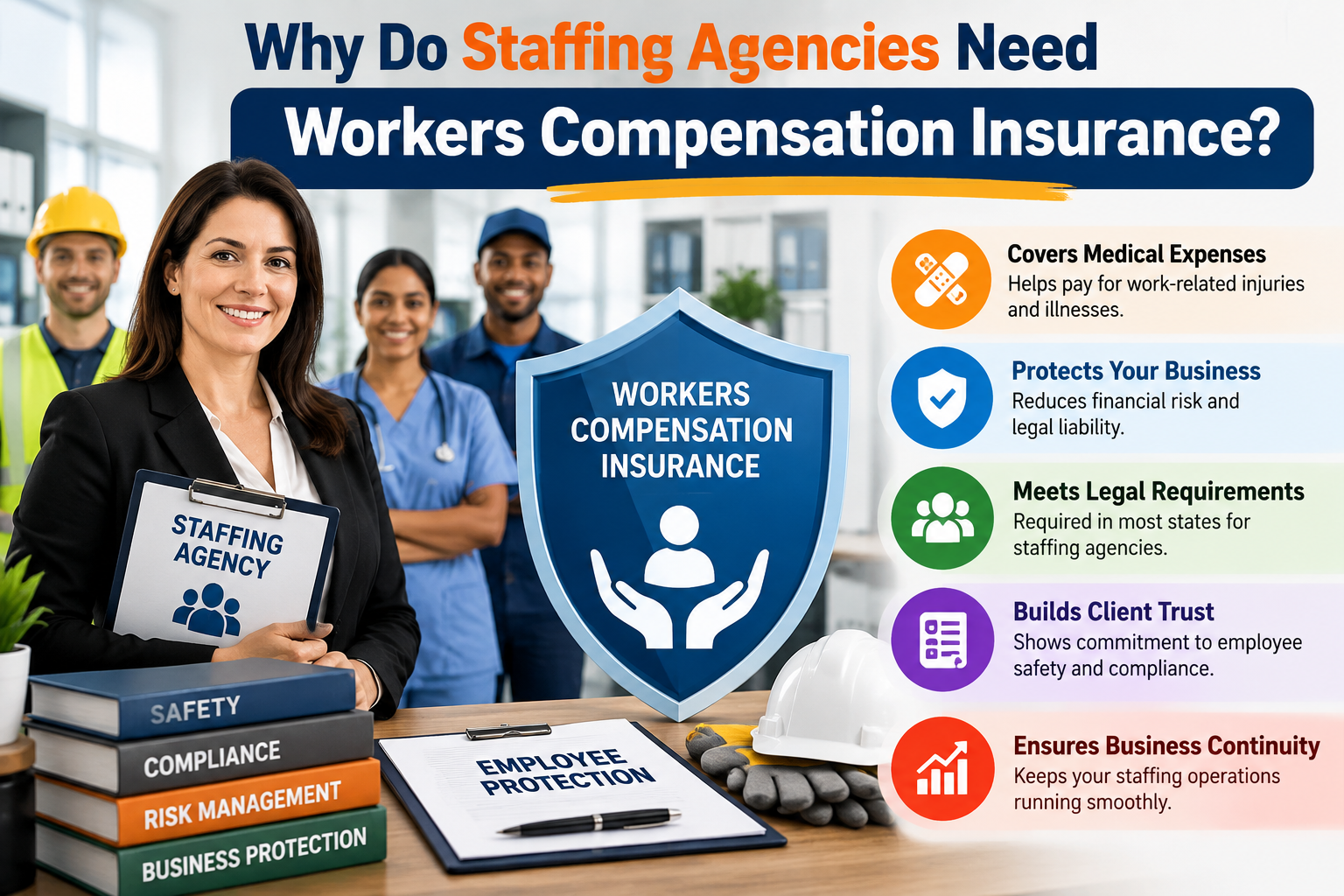
Why Do Staffing Agencies Need Workers Compensation Insurance?
Staffing agencies place employees with different client businesses, which means their workers may perform many types of jobs and work in different environments. This creates workers compensation risks that a regular office-based business may not face.
Workers compensation insurance helps protect employees when they suffer a work-related injury or illness and also helps staffing agencies handle the financial and legal responsibilities that can follow a workplace accident. In California, employers with one or more employees generally must provide workers compensation coverage.
For staffing agencies, having the right coverage is especially important because the agency, the assigned worker, and the client workplace can all be connected to the employment arrangement.
Why Is Workers Compensation Important For Staffing Agencies?
A staffing agency does more than recruit workers. It may hire employees, manage payroll, assign them to client businesses, and handle employment-related responsibilities.
When an employee is injured while working, the agency may need to respond quickly and coordinate with the insurance carrier and client business.
Workers compensation can help provide benefits for covered work-related injuries and illnesses, including medical care and disability benefits when applicable.
Without proper coverage, an agency can face serious financial and operational problems.
Staffing Agencies Can Have Different Workplace Risks
One staffing agency may place workers in offices, warehouses, restaurants, construction-related jobs, manufacturing facilities, or other workplaces.
Each placement can have different levels of risk.
For example, an office worker may face different hazards from a worker performing physical labor. An agency that places employees into several types of jobs needs to give its insurance provider accurate information about the work its employees actually perform.
The type of work, payroll, claims history, and business classification can affect workers compensation premium calculations.
Who Is Responsible When A Temporary Worker Gets Hurt?
This is one of the most important questions for staffing agencies.
A temporary worker may have an employment relationship with the staffing agency while working under the supervision of a client business. California recognizes situations where temporary agency workers have both a primary employer and a host workplace employer.
That means the agency should not assume that sending a worker to a client automatically removes its responsibilities.
The staffing agency should have a clear process for:
Reporting workplace injuries
Contacting the workers compensation carrier
Providing required claim information
Communicating with the client
Recording the details of the incident
Following up with the injured employee
The exact responsibilities can depend on the employment arrangement and circumstances of the claim.
What Does Workers Compensation Cover?
Workers compensation is designed to provide benefits for covered work-related injuries and illnesses.
Depending on the situation, benefits can include:
Medical treatment
Temporary disability benefits
Permanent disability benefits
Supplemental job displacement benefits
Return-to-work benefits
Death benefits for eligible dependents
California’s workers compensation system provides these benefits without requiring an employee to prove that the employer was at fault for the workplace injury.
For a staffing agency, this can provide an important financial protection when an employee experiences a serious workplace injury.
Why Client Workplaces Create Additional Risk
Staffing agencies do not always control the location where their employees perform their daily work.
A client may control the worker’s daily tasks, equipment, schedule, or work environment. At the same time, the staffing agency may remain involved in employment, payroll, and insurance matters.
California’s workplace safety information for temporary agencies recognizes this type of dual-employer arrangement and notes that both the staffing agency and host employer can have workplace safety responsibilities.
Because of this, staffing agencies should carefully review the workplaces and jobs where they send employees.
Why Accurate Employee Information Matters
A workers compensation policy needs accurate information about the staffing agency’s operations.
Problems can occur when an agency gives incomplete information about:
The types of workers it places
The jobs employees perform
Employee payroll
Work locations
Changes in business operations
Previous workplace claims
Accurate information helps the insurance provider understand the actual business risk and helps the agency maintain coverage that matches its operations.
California’s DWC notes that payroll, industry classification, and prior claim experience are among the factors that can affect workers compensation premiums.
What Happens If A Staffing Agency Does Not Have Proper Coverage?
Operating without required workers compensation coverage can create serious consequences.
California requires employers to provide workers compensation benefits to employees, and failing to maintain required coverage can result in penalties and other legal problems.
For a staffing agency, the risk can be even more serious because workers are being placed with outside businesses.
One workplace injury can create unexpected costs if the agency does not have valid and appropriate coverage.
Can Part-Time Or Temporary Workers Be Covered?
Yes. Temporary and part-time employees can be eligible for workers compensation benefits when they suffer a qualifying work-related injury or illness.
Staffing agencies should therefore avoid assuming that a worker does not need coverage simply because the assignment is short-term, seasonal, or part-time.
The agency should discuss its complete workforce structure with its insurance professional and make sure its policy reflects how it actually operates.
How Can Staffing Agencies Reduce Workers Compensation Problems?
Insurance is important, but good risk management can also reduce problems.
Before sending an employee to a client, a staffing agency should understand the job being performed and the basic workplace risks involved.
Useful steps include:
Confirm the employee’s actual job duties.
Collect accurate information about the client workplace.
Make sure employees receive appropriate safety information.
Maintain clear injury-reporting procedures.
Communicate with clients about workplace hazards.
Keep payroll and employee records accurate.
Review claims and recurring injury patterns.
Update the insurance provider when business operations change.
Good communication between the staffing agency and client can make it easier to respond when an injury occurs.
Why Should Staffing Agencies Review Their Coverage Regularly?
A staffing agency’s operations can change quickly.
The agency may add new types of workers, take on new clients, increase payroll, change the type of jobs it fills, or begin placing employees in higher-risk work.
Those changes should not be ignored.
Regular policy reviews can help identify whether the current workers compensation coverage still matches the agency’s business activities.
How Redvo Insurance Solutions Can Help
Choosing workers compensation coverage for a staffing agency requires more than simply looking for the lowest premium.
Redvo Insurance Solutions has 15+ years of experience helping businesses with insurance needs. Staffing agencies can contact Redvo Insurance Solutions at 1800-411-0733 to discuss their workers compensation insurance needs and get help reviewing coverage options.
The right policy should reflect the agency’s employees, payroll, job placements, and actual business operations.
Conclusion
Staffing agencies need workers compensation insurance because their employees can face workplace injuries while working under different assignments and in different environments. Proper coverage helps protect workers and gives the agency a structured way to handle covered workplace injury claims.
For staffing agencies, accurate employee information, clear communication with client businesses, proper risk management, and regular policy reviews are just as important as choosing the insurance policy itself.